Introduction
Theatre is a school subject in Sweden, taught at upper secondary school level as part of the three-year National Aesthetic Programme[1]. In Sweden, theatre is recognized as an arts subject at the upper secondary school level, forming part of the preparatory national arts program. This program also encompasses specializations in dance, art and design, aesthetics and media, and music. As a preparatory program, it readies students for further studies in both artistic and academic disciplines at the tertiary level. Theatre has been integrated into the national arts curriculum since 1994, including its own syllabus and grading criteria. Typically, students enter the three-year program at the upper secondary school at the age of 16. The curriculum aims to include both practical skills and theoretical understanding (Teater, 2025).
In this paper, examples and analyses are presented from a theatre classroom. This study is part of a larger research project in which we examine teaching that is aimed at rehearsing a stage production in the school subjects of dance and theatre.[2] The researchers involved in the project have backgrounds as dance and theatre teachers at upper secondary school level. In the project they participate as researchers only, however, their experiences as former teachers were useful for the follow-up discussions with the teachers and general observations.
Master–apprentice tradition
In theatre teaching practice, there is an ongoing debate about the master–apprentice tradition, where theatre, both as an art form (professional theatre) and as a school subject, has been criticised for the power imbalance between the theatre director/teacher and the students (Petersen Jensen & Lazarus, 2014; Seton, 2020; Tuisku, 2015). A consequence of this discussion is that student-centred methods are being increasingly used, where, for example, instead of asking the student to act in a certain way, the teacher asks questions to let the student find his or her own way of acting (Göthberg, 2019; Lazarus, 2012). However, an effect of this may be that the teacher steps back into what can be described as a supervising position and that the teacher’s know-how, the subject-specific and embodied knowledge involved in the feedback situation, becomes embedded. By embedded, we mean that the know-how is expressed in metaphors or just indicated using body language and/or non-verbal sounds. From the perspective of the student, this feedback can be described as vague or unclear. Therefore, in an educational setting, it is important to become aware of the know-how that is embedded in the feedback and find ways to make it explicit to support student learning (Ahlstrand & Andersson, forthcoming).
Literature on feedback
In the international field of assessment, there are many studies that support the idea that feedback promotes students’ learning and that feedback is a central part of formative learning/assessment/teaching (Black & Wiliam, 2009; Hattie & Timperley, 2007; D. Sadler, 2010; R. D. Sadler, 1989, 2013), where this is usually discussed in relation to feedback on students’ written or verbal assignments. A problematic consequence of formative assessment may be that assessment practice governs the learning process, that is, assessment as learning (Torrance, 2012). In addition, previous research has discussed teachers’ difficulties in verbalizing and articulating grounds for assessment and qualitative aspects of knowledge (Gåfvels, 2016; Hudson et al., 2017; Öhman & Tanner, 2017; Skovholt, 2018; Zandén & Ferm Thorgersen, 2015). The interaction between students and teachers in the classroom situation has been studied by focusing on feedback as an assessment practice (Boistrup, 2010; Murtagh, 2014; Solem & Skovholt, 2019). Teachers may experience that they clearly communicate criteria for feedback, even if this is not what the students experience (Hogan, 2019; Mapplebeck & Dunlop, 2019). Previous studies and research reviews suggest the need for more studies regarding feedback in the classroom (Baird et al., 2014; Ruiz-Primo & Brookhart, 2018).
International research is severely limited in terms of studies that address assessment issues at upper-secondary level in theatre. There are some studies in theatre education where assessment questions are specifically addressed but these are at primary-school level (Chen & Andrade, 2018) or in higher education (Mello, 2007). Some studies report on teachers’ challenges relating to policy and assessment (Jacobs, 2020), but as Chen and Andrade (2018) state: “The impact of formative assessment on student theatre arts learning, however, has barely been examined” (Chen & Andrade, 2018, p. 312). One exception is Hogan (2019) whose study explores how secondary drama students describe their experiences of teacher feedback and if and how the feedback effects their learning. The findings suggest that students utilise contextual, social and individual learning filters to assess the usefulness or value of teacher feedback. Hogan suggests that drama teachers should establish positive social, relational and artistic interactions in the drama classroom in order for students to engage in the feedback.
Rehearsals of a stage production
In the teaching practice of rehearsing a stage production, the teacher usually has the role of a director and this can be related to the previously mentioned master–apprentice tradition, where the teacher gives suggestions for the students to try in the acting situations but also invites the students to come up with their own suggestions in the rehearsal work. Typically, in this kind of rehearsal, a few students at a time are rehearsing a scene from the play together with the teacher, while the other students are either studying lines from it (other scenes that have been or will be rehearsed) or working on costumes, props and/or scenography. Sometimes students watch the rehearsals if they do not have any other assignments at the time. Other teaching practices are also used during the students’ three years of theatre studies in upper secondary school, for example working with devising as a method for creating a stage production, where the students can be involved in developing and creating the performance (Milling & Heddon, 2015; Munk et al., 2024).
During rehearsals of a stage production like the one described above, situations arise when the teacher intervenes in the ongoing rehearsal process, usually as a result of having identified difficulties or merits relating to the students’ performances in acting. These may be described as didactic interventions, with this term being used to describe feedback aimed at sharing expected or desirable knowledge in a specific teaching situation (Ahlstrand, 2020). We consider didactic interventions to be a form of feedback, representing the teacher’s professional judgement, or subject-specific know-how, in a specific teaching situation. However, this know-how is seldom articulated, but is instead often expressed using brief evaluative judgments like “good”, metaphors, non-verbal sounds or body language, such as gestures or physically correcting the student’s body (Andersson, 2016; Englund & Sandstrom, 2015). Even if it appears that the feedback is given spontaneously and intuitively, this is a core situation that has the potential to be a starting point for structured teaching, and whole-class teaching, as we will show in the examples below (cf. Ahlstrand & Andersson, 2021b, 2024b, 2024a. In this study we are interested in examining how to enhance teacher practices and strengthen students’ capabilities using a theory of learning entitled variation theory.
Variation theory has its origins in a phenomenographic tradition (which has its roots in phenomenology, see Marton, 1981) and describes learning as being able to discern new aspects of a phenomenon. A more complex way of knowing something is described as a more advanced way of discerning, and by experiencing variation, one can discern different aspects of a phenomenon (Carlgren et al., 2015; Marton & Pang, 2006; Runesson & Marton, 2002). In this article we examine the value of applying this theory to strengthen student work in relation to interplay – the interactions between students when acting.
In a later section, a more detailed discussion of variation theory is offered, but for now it is essential to understand that there is an assumption within variation theory that “in order to distinguish two aspects that have not been distinguished previously, a difference between them has to be created by letting one vary, while the other remains invariant” (Marton, 2015, p. 49). In theatre work, this could mean that the students work on the same dialogue (invariant) and alter how the voice is used when performing the text (varied). The patterns of variation within variation theory have been developed over many years of classroom research based on experiences and results in relation to various phenomena (Marton, 2015; Runesson, 2006; Runesson & Kullberg, 2010).
Problem description, aims and research question
The study addresses two problems described above: that although feedback in the rehearsal process can contain important subject-specific know-how, there is a risk that this know-how is embedded in the feedback and may not be easily accessible to the students; and that feedback is too often given to only a few students and by chance depending on how a rehearsal process is organized, as described above. A rehearsal process involves various types of subject-specific know-how, but the focus in this study is delimited to interplay. Interplay, a core capability in acting, is highlighted in the Swedish curricula (Teater, 2025). Interplay is a complex capability, in the sense that it involves different ways of knowing in acting (c.f Carlgren et al., 2015), and in this study we decided that one delimited part of interplay, namely contact, would be the focus of the teaching process. In variation theory contact would therefore be called the object of learning (Marton, 2015, 2018). Contact[3] was chosen as a result of studying the didactic interventions in the rehearsal process, and noting that there were 15 occasions where contact was emphasised by the teacher. At these times the teacher sometimes intervened to indicate when the students were in contact with each other in the acting situation, but mostly to draw attention to when the students were not in contact with each other. In other words, it seemed to be important for the students to learn about contact in order to develop interplay.
To address these problems, three concepts from variation theory (contrast, generalisation and fusion) are applied to understand how tacit knowledge practice can be made more explicit when teaching in a structured and theory-driven way. These concepts are introduced below.
The aims of this study are twofold. One aim is to explore how the patterns of variation (contrast, generalisation, and fusion) can be used with the intention of making the embedded know-how involved in the teacher’s feedback explicit, and the other is to create opportunities for the students to experience variation and discern different aspects of interplay when acting. The research question is formulated as follows: How can the know-how involved in the teacher’s feedback within theatre rehearsals be made explicit by teaching in a more in a structured and theory-driven way?
Theoretical and analytic framework - Tacit knowing and variation theory
As mentioned previously, the feedback offered during theatre rehearsals may include assumptions about subject-specific know-how, although they may be embedded. In the words of Polanyi:
Tacit knowing is shown to account (1) for a valid knowledge of a problem, (2) for the scientist´s capacity to pursue it, guided by his (sic) sense of approaching its solution, and (3) for a valid anticipation of the yet indeterminate implications of the discovery arrived at in the end. Such indeterminate commitments are necessarily involved in any act of knowing based on indwelling. For such an act relies on interiorizing particulars to which we are not attending and which, therefore, we may not be able to specify and relies further on our attending from these unspecifiable particulars to a comprehensive entity connecting them in a way we cannot define. (Polanyi, 1966/2009, p. 24)
Even though Polanyi uses the scientist as example above, this can also relate to teachers´ know-how, including in the rehearsal situation. Polanyi describes this know-how in the quotation above as an “act of knowing based on indwelling”. Here indwelling refers to how the teacher’s subject-specific know-how has developed as a result of being part of a particular practice, namely, artistic theatre practice. In this study, the aim is to try to find a way to specify what Polanyi calls “unspecifiable particulars to a comprehensive entity”. Even though we, like Polanyi, are aware that we will not be able to define all aspects involved in “the act of knowing”, we still argue that some central aspects involved in the feedback can be articulated. Polanyi discusses this in relation to Meno’s paradox[4], explaining how the teacher can, as it seems, give feedback spontaneously and intuitively:
This kind of knowing solves the paradox of the Meno by making it possible for us to know something so indeterminate as a problem or a hunch, but when the use of this faculty turns out to be an indispensable element of all knowing, we are forced to conclude that all knowledge is of the same kind as the knowledge of a problem. (Polanyi, 1966/2009, p. 24)
The problem mentioned in the quote above can be exemplified by the teacher giving feedback in the rehearsals and asking the student to change something in the acting based on the theatre tradition this play is set in. If the rehearsals are set in a Stanislavski tradition,[5] the teacher can, as it seems intuitively, react to a student’s acting if it is not in line with the tradition. The teacher identifies the problem in the student’s acting since the teacher, from earlier experience and based on his/her own embodied know-how, has “the knowledge of a problem” (Polanyi, 1966/2009, p. 24). By articulating aspects involved in the problem and by using a theory of learning, teaching situations that help to solve Meno’s paradox can be created, as shown in the results section.
Variation theory
In variation theory (Kullberg et al., 2024), the term “critical aspect” is used to describe parts of the content, that have proven to be challenging for students to discern. Identifying a critical aspect and planning teaching using the critical aspect as a starting point, can make what is critical more accessible for the students. The following patterns of variation are used when planning and analysing teaching guided by variation theory:
-
Contrast: Variation of the critical aspect by the use of counterexamples (what something is not) to give the students the opportunity to visualise/experience what something is. For example, in a theatre rehearsal this could mean working on text material in different genres/theatre traditions.
-
Generalisation: The aspect that is supposed to be discerned is kept invariant while another aspect is varied. For example, and as mentioned before, this could mean that the students work on the same dialogue (invariant) and alter how the voice is used when performing the text (varied).
-
Fusion: Several critical aspects are varied at the same time in order to be able to distinguish several aspects simultaneously. For example, this could mean to varying voice and body in a dialogue.
Different ways of knowing can be studied as bodily expressions when students act. Moreover, knowing can be studied in the teacher’s feedback, when the teacher draws attention to the knowing that is either acknowledged or desired in the students’ acting. For example, in relation to this material, the teacher gave feedback in one of the earlier rehearsals saying only “good contact”. How the students acted was assessed as good contact but without an explanation of what was good or why. In a tacit knowledge epistemology, this can be understood as what Goodman calls ostension, which “like exemplification, has to do with samples; but whereas ostension is the act of pointing to a sample [“good contact”], exemplification is the relation between a sample and what it refers to” (Goodman, 1969, p. 53). In this study, we argue that when the teacher consciously and systematically presents examples, with the help of the patterns of variation, “the relation between a sample and what it refers to” can become clearer for the student and can be a way to support student learning.
In the project we use critical aspects as a starting point to study how it can be possible to articulate the knowing involved in the object of learning. This will contribute to a greater understanding of what it means to know the object of learning (Carlgren et al., 2015). Further, they help to identify how and what to teach in order to give the students the possibility to grasp the object of learning.
Method and material
The design of the overall research project, of which this study is one part, consisted of three steps. In the first step, rehearsals of a stage production were video recorded by the researcher. The focus was on the didactic interventions, explained above. In the second step, feedback situations (didactic interventions) were identified in the material and stimulated recall was used (Haglund, 2003; O ́Brien, 1993). This meant that the researcher and teachers studied a selection of the video recordings of the didactic interventions and had in-depth conversation about them. These were audio-recorded. The third step involved planning and enacting five structured focus lessons, conducted as whole-class teaching based on didactic interventions, where variation theory was used as a theory of teaching (Marton, 2018; Marton & Pang, 2006; Sanders et al., 2022). The third step is the focus of this paper. Specifically, we report here on results from the fourth focus lesson where variation theory was used both as a theoretical tool when planning the lesson and as an analytical tool when analysing the filmed material. When planning Lesson 4, the aim was to enhance student understanding of the intensity within interplay.
Approach and Participants
One of the researchers followed and filmed the rehearsal process of a theatre play at upper secondary level in a school in Sweden. The play was an abbreviated version of Caucasian Chalk Circle by Bertolt Brecht. It was created by the teacher in charge of the stage production assignment. The rehearsals/assignment started in August 2022 with a public performance as the goal, and the play was performed in March 2023. One team of teachers of theatre (four teachers) and one researcher, were involved in the study, along with 12 students. The students were in their third year of studying theatre and were aged 17–18. Although the whole teacher team was involved in analysing parts of the filmed material, only one teacher worked with the students when creating the performance. Using critical aspects as a starting point, the teacher and one of the researchers planned five structured focus lessons, which were conducted between December 2022 and February 2023. The critical aspects involved in the planning of the focus lessons were: space/distance (Lesson 1); physical expressions (Lesson 2); breaking borders (Lesson 3); intensity (Lesson 4); and timing (Lesson 5) (see Ahlstrand & Andersson, 2024b). The five focus lessons were part of the ongoing performance work and involved all students in different exercises. Excerpts from Lesson 4 are provided in the results section below.
Ethics
The project took into consideration the ethical principles given by the Swedish Research Council. Besides considering the key principles reliability, honesty, respect and accountability (ALLEA, 2023; Vetenskapsrådet, 2024) the different roles that the teachers and researchers had in the project should also be noted, including the fact that the teachers acted as co-researchers in planning the research lessons and were involved in some of the analysis processes, while the researchers had the overall responsibility for planning the project, analysing the material and spreading the results in both publications and at conferences.
Analysis
As previously noted, it is necessary for students to discern certain aspects, so-called critical aspects of an object of learning in order to be able to experience the object of learning in the intended way (Marton, 2015). During the process of analysing the filmed material and when planning the focus lessons, using variation theory, critical aspects of the object of learning appeared. We analysed what knowledge had been the attention for the teachers’ feedback in the didactic interventions and, in line with variation theory, found that intensity was critical for students’ contact and thus for developing interplay with each other. In the following section, we will give examples of how patterns of variation were used to develop students’ understanding of intensity and also offer an example of how an additional critical aspect, which was not planned for, emerged in the teaching situation.
Lesson Four
Different degrees of intensity
At the beginning of Lesson Four, the teacher reminded the students that the overall focus was to investigate “the contact between actors”. The teacher also reminded the students of the other critical aspects they had worked on in the previous focus lessons in relation to contact. Excerpt one highlights how the teacher introduced the lesson.
Excerpt 1, Lesson 4:
We have been investigating, for quite some time now, the contact between actors. And that’s what will make this performance work or not work. Then it is also the case that with increased contact it just gets better and better. So, it’s not just on and off, we have or don’t have contact, but it is possible to cultivate the contact. There are lots of things to investigate in the contact and we have done so. Do you remember? We’ve used this thing about examining different volumes when we talk to each other. It was one thing. We have also investigated different distances. Well, what happens now? [the teacher moves closer to one of the students] And what about greater distances? [the teacher moves further away from the same student to illustrate how the contact changes when using different distances]. We have tried with the body´s territory… to break it.
The next excerpt shows how intensity was then introduced by the teacher, contrasting intensity with lack of intensity.
Excerpt 2, Lesson 4:
Today we try…intensity. We are looking into it. You can have it and you can not have it… not intensity. But it is also the case that when you have it, then it can take slightly different forms of expression. So, we will look into that today.
The teacher introduces a variation in intensity by showing in their own body that there are different ways of expressing intensity in the movements. To start with they point one finger, but rather carelessly, without much intensity.
Excerpt 3, Lesson 4:
Yes, and then …the fact that we can have different intensities in the movements. So we can, for example, if I point … [name of the teacher] is pointing.
The teacher then shows the movement of pointing a second time, expressing more intensity. Finally, the teacher shows the movement of pointing a third time (Excerpt 4).
Excerpt 4, Lesson 4
It kind of works. I do it, I point [referring to the second time]. But I can raise the intensity. Everyone is looking at me now. That is something else. And then it can look like this. Now I’m doing it all I can. Everyone is looking at me.
At this moment, the movement of pointing is expressed more intensely, with the teacher pointing with their finger, hand and arm more extended. Their feet are spread and the whole body is more tensed compared to the versions in previous excerpts.
Excerpt 5, Lesson 4:
There are different degrees of intensity. We do it like this! We have worked on different exercises in different pairs [referring to the previous focus lessons]. We will do that now. We pair up, in different pairs this time.
The example is important for showing that working with the pattern of variation contrast does not mean focusing on a contrast simply in terms of a strict opposite or counterexample. The knowing is seldom either/or. There are different degrees of expressing intensity, and in theatre this depends, for example, on the situation within the scene, the characters’ different personalities, the conflict between the characters, and characters´ motivations. These circumstances will affect the contact, and therefore the interplay, between actors.
Improvisation exercises and the appearance of another critical aspect
After the students had paired up, they were given instructions for an exercise where they were supposed to improvise a situation, imagining they were in a relationship where one of the partners wants to break off the relationship and the other wants them to stay together forever. The teacher reminded the students that this, being an example of a conflict, is related to the play they are rehearsing, since in the play there are several conflicts. But the main thing with the exercise is to let the students experience the contrast between different ways of expressing intensity. As a first step, all pairs improvised at the same time, as a way to warm up. As a second step, one pair at a time improvised in front of the others and the teacher gave further instructions to the pairs, mainly asking them to try improvising in an intense or a non-intense way as a contrast. In between the different improvisations in pairs, the teacher invited the students to reflect on what they had seen in the improvisation regarding a variation in intensity. The teacher then let the students who were acting reflect on what they had experienced when acting in more or less intense ways.
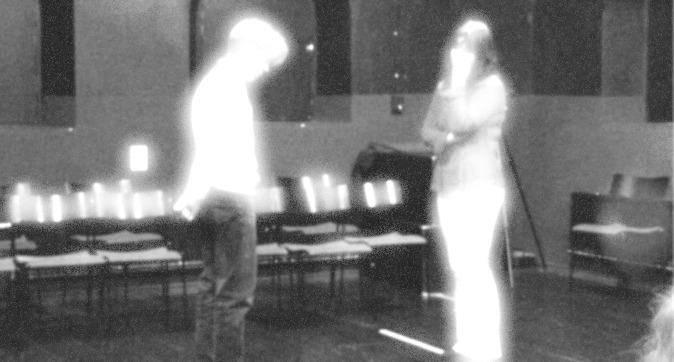
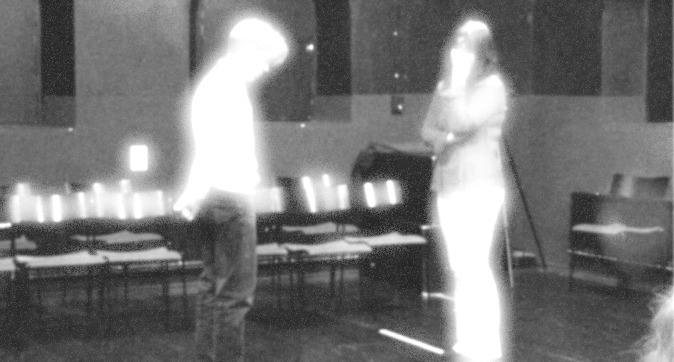
When the third pair of students were improvising, a situation arose where, even though the students had been asked to improvise the scene with intensity, not very much was happening in the acting. As shown in Figure 1, the students’ bodies were stiff, and at times, they looked away from each other during the dialogue. For example, one student was looking down at the floor while the other student was hiding her face in her hand. Since the students were not in contact, the teacher interrupted and asked the students to keep working on the intensity but also reminded them about being aware of the distance between them and how this could influence the contact between them.
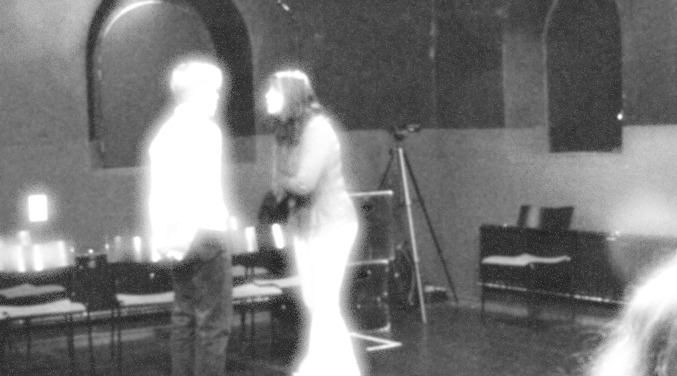
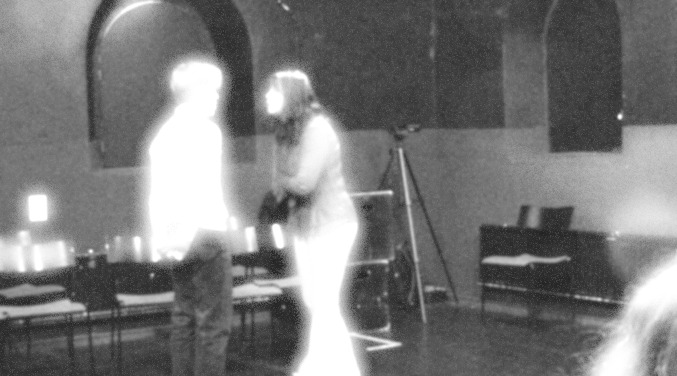
After the students were reminded by the teacher to more consciously use the distance between them, which had been worked on during Lesson 1, as well as being reminded to keep investigating intensity, there was a clear difference in the students’ contact with each other. This is shown in Figure 2 but also shown in the excerpts below, where the teacher asks both the students acting and the students watching to reflect upon what they experienced in relation to how the distance and intensity affected the contact in the acting situation.
When the teacher asked the students who were acting how they experienced the improvisation, Student 1, as shown in the excerpt below, described a feeling of being uncomfortable when it gets intense, since it is hard to be responsive to the other person. Speaking in variation theory terms, one can identify responsiveness as a critical aspect that appeared during Lesson 4. When planning this lesson, the teacher and researcher focused on giving the students opportunities to experience variation in intensity, as a way to make it possible for the students to experience contact in interplay. Using this structured way of letting the students work with the contrast between intensity and lack of intensity, allowed another critical aspect, responsiveness, to be identified by the students when acting. In the excerpt below, what the student identified as necessary for developing contact was described as being able to be responsive at the same time as having intensity.
Excerpt 6, Lesson 4:
Teacher: Can you describe yourself, as actors, what did you experience? With this difference when it is not intense and when it is intense?
Student 1: It gets a little uncomfortable…
Teacher: A little uncomfortable?
Student 1: No, but it feels a bit… I don’t know…
Teacher: Go ahead!
Student 1: No, but I guess [—] It is not so responsive. But it is more full on from both of us [—]. You end up throwing things at each other a little bit all the time.
Teacher: Hey, what an exciting point of view! It is not so responsive.
Student 1: No, because you have your own will and when it gets so intense, it becomes … And then you really want to get it across.
Teacher: In that case, we will test this. Maintain the intensity. See if you can also be responsive.
Student 2: We should listen more to the other?
Teacher: Yes, and still the focus is the contact. What happens between you? Try [to the students acting], everyone is watching [to students sitting nearby and watching]. Let’s start now.
After the students who were acting tried the improvisation one more time, the teacher asked the students who were sitting next to the stage and watching if they could describe what they had experienced when watching this version in comparison to the previous version of the same improvisation.
Excerpt 7, Lesson 4:
Teacher: You who are watching. How would you describe that last version? Was there contact? [students are saying yes and/or nodding their heads].
Teacher: [name of student], can you describe more what the contact looked like?
Student 3: It feels like they related to each other more somehow.
Teacher: [name of student] do you want to say?
Student 4: It feels like they react more to what they say as [name of student] just said. They talked more with each other instead of talking at each other.
Teacher: What a good example! We can make use of this actually, so that the intensity does not just become a blind intensity. So, there is also some responsiveness in it [in the sense of being in contact]. Then I think we should use this now. In short sections of the text from the play.
Using concepts from variation theory, it can be said that two critical aspects have been identified: intensity in the planning of the lesson and responsiveness (to the other actor and the situation in the play) during it. We see within the excerpts above that the teacher suggests that both aspects should be used in the upcoming scenes when continuing to rehearse the theatre play. When different critical aspects are varied at the same time in order to let students be able to distinguish several aspects at once, this pattern of variation is called fusion.
This was practised when the students continued to rehearse scenes from the play, where they were asked by the teacher to investigate how using the contrast between different levels of intensity would affect the contact between the actors. The students were also reminded of, and were asked to put into words, how what the different characters’ motivations affects the level of responsiveness in the acting in the different situations. In this theatre tradition, it is considered that a character in a scene needs to want something in order to make the scene urgent and interesting as an acting and performing situation (Carnicke, 2000).
What the students experienced in the improvisation exercises, both when acting and when watching, was planned for and it was expected that they would carry this with them into a new context, that is, the scenes of the theatre play. As mentioned before, when an aspect that is supposed to be discerned is kept invariant while another aspect is varied, this pattern of variation is called generalisation. Here intensity is kept invariant while the situation or context varies.
From exercises to rehearsals of the scenes in the play
All the students were then given the opportunity to rehearse one of the scenes from the play that they had an active part in. They were given instructions to create a contrast between levels of intensity when acting out the different scenes. After the first rehearsal of one of the scenes, where the students had tried to act with less intensity, the teacher asked the students sitting and watching about their experience of the scene.
Excerpt 8, Lesson 4:
Teacher: Okay [name of a student]. Was it not intense?
Student 5: Yes.
Teacher: Yes, it was. Good, then we do it again. Okay, what will we take now?
Student 6: Super intense.
Teacher: Wow. Surprise us all. Look, look at the difference now [talking to the students watching]. Let’s start now.
After the second rehearsal (with intensity), the teacher again asked the opinions of the students watching.
Excerpt 9, Lesson 4:
Teacher: Thank you! Okay [name of a student], was there any difference?
Student 7: Well, when the intensity is increased, the voice often becomes a little louder and the body language more intense.
Teacher: Yes. Uh. Was there any difference during the scene? Was there any difference in [name of student]’s way of acting?
Student 7: Yes, I think so. Or at the beginning it was a little calmer and then it kind of escalated.
Teacher: [name of student who acted].
Student 6: Yes.
Teacher: Do you agree?
Student 6: Yes.
Teacher: Good. What happened? [—]. This thing that it…. looked like… as if there was an increased intensity. What was it that made it look like that?
Student 6: It became very intense in the scene and….
Teacher: Intense in the scene. Yes. What does that mean?
Student 6: To… I don’t know… that the governor is annoying and she… is just talking about the clothes…
Teacher: Aha! Take note of that. But we’ll keep this, and we’ll also think about… What is it we want in the scene? [name of one of the characters in the play, played by one of the students] What is it you want?
Within this except, the teacher reminds the students about character motivation in order to draw attention to how this affects responsiveness when working with contact between the actors. Since the critical aspect of responsiveness appeared during the lesson, the teacher was not able to plan to let the students work on responsiveness in a more systematic way, but nevertheless reminded the students that what the different characters want in the scene makes a difference in the acting. This is something which could be further investigated (see Ahlstrand & Andersson, 2021b), as it helps the students distinguish several aspects at once. This pattern of variation is called fusion.
When asking the students to again explain what the different characters want in the scene, the overall situation in the scene was also clarified once again. As the scene is about escaping from being attacked in a war situation, it was important for the students to create a sense of urgency, and here the teacher reminds the students that this relates to what the different characters motivation. After trying the scene a third time, the teacher turns and questions the students watching.
Excerpt 10, Lesson 4
Teacher: How was it?
Student 8: It was very good.
Teacher: It was very good! [turns to the students acting] That means if you want this to be “very good” in the performance, later, then you should use this. Wow, nice job! Then we are satisfied there. We’ll move on to the next scene.
The teacher refers to “the performance” in the excerpt above, meaning when the students are supposed to perform the play for an audience.
Discussion and conclusions
In this section, we will address the research question concerning how know-how involved in the teacher’s feedback can be made explicit when teaching about interplay in a structured and theory-driven way. We put forward the main conclusions of the study which we suggest challenge traditional ways of teaching theatre.
Challenging a traditional way of teaching
There is a risk, when working with student-centred methods, that the teacher’s know-how about the subject becomes blurred or hidden, or that the feedback given is embedded (Ahlstrand & Andersson, forthcoming). To address this concern identified critical aspects were used to plan the five focus lessons, as mentioned previously: space/distance (Lesson 1); physical expressions (Lesson 2); breaking borders (Lesson 3); intensity (Lesson 4); and timing (Lesson 5). During Lesson Four, the students identified an additional critical aspect, responsiveness. Since the teacher was attentive in the situation, he used this in his subsequent instructions to the students. By being reminded about what the different characters motivations, the students were given the opportunity to work on intensity and responsiveness at the same time when continuing to rehearse the scenes from the play. Whether this was a consequence of the teacher’s experience of studying variation theory and in that sense using a student’s comment to identify a critical aspect, it is hard to say, but this could be a sign of a development in this teacher’s teaching practice. In any case, the way the focus lessons were planned, using variation theory, challenges a traditional way of working with theatre as a school subject, which we will continue to discuss below.
A limited number of aspects in acting—a help or a risk?
One conclusion drawn from this study is that it can be helpful for students to be able to work with a limited number of aspects in relation to acting. In the research project as a whole, five critical aspects of the object of learning contact were identified and then an additional critical aspect, responsiveness, appeared during Lesson 4. In this paper, the focus is on intensity, although the teacher in Lesson 4 reminded the students of how using distance could influence the acting. However, these are not the only aspects involved in the object of learning. One risk when working on a limited number of aspects is that the students may be confused if they think that the chosen aspects are the right answer to how to act in a certain way. Therefore, it is important to stress, as the teacher does, when showing intensity in his own body, that there is a variety of intensity needs to be explored. This is why the teacher says in Excerpt 3, “we can have different intensities”. Additionally, the way of teaching that is described in the results section, concentrating on one aspect at a time, can at first be a confusing way for students to rehearse. Figure 1 shows a situation where the students do not have contact since their bodies are stiff and they do not look at each other, which can be a consequence of focusing on an intense way of acting, and in this case led to a lack of contact. Here the teacher, as always, needs to be responsive to the students (c.f Hogan, 2019), and in this situation, the teacher reminded the students about being aware of the distance between them and how this could affect the contact between them. This, together with working on intensity, helped to increase the contact between the students.
Pointing to a sample as a shared reference to relate to
When introducing intensity, the teacher shows different levels of intensity in his own body. This can be understood in relation to the concept of ostention as used by Goodman, which is the “the act of pointing to a sample” in contrast to exemplification, which is “the relation between a sample and what it refers to” (Goodman, 1969, p. 53). The teacher uses the gesture of pointing when he highlights pointing with different levels of intensity. His gesture is in that way a sample, which, if grasped by the students, can be a useful reference for them. Then, when the students are given the opportunity to experience in their own bodies the contrast between intensity and lack of intensity, this can be understood as a “sample and what it refers to”. The students are given examples that refer to intensity by trying out levels of intensity in their bodies. The way the teacher shows different intensities in his own body could, in relation to the discussion about the master–apprenticeship tradition, be criticised as the teacher giving the students “the correct answer”. We argue against this, since throughout Lesson 4 the teacher stresses that there are different ways of expressing intensity. One example of this is occurs in in Excerpt 2, where the teacher says: “But it is also the case that when you have it [referring to intensity], then it can take slightly different forms of expression”. This highlights the importance of the conscious use of samples, which can as well be related to Hudson’s study (2019) where the students wish for concrete examples in the teacher’s feedback.
Step by step…
Another conclusion is that it can be helpful for students to try to separate different aspects in acting, step by step. In Lesson Four, as a first step, the students were given the opportunity to experience the contrast between different levels of intensity in an improvisation exercise. Then intensity was generalised by rehearsing short scenes from the play. In relation to this step, the teacher reminded the students of an aspect they had worked on before, as part of both oral and written analyses: what the characters want. In the acting situation, knowing this was a prerequisite for judging what grade of intensity could be appropriate in the different scenes. Even though we argue that patterns of variation can be a powerful tool when working with theatre in a structured way, it is still important to pay attention to how the object of learning “unpacks” in the classroom (Björkholm, 2015). As seen in the results section, another critical aspect, responsiveness, was identified when students tried out the contrast between different levels of intensity and one student described feeling uncomfortable when the intensity became too strong. This comment was picked up by the teacher and was treated as a critical aspect that needed to be considered and related to when starting to work on the scenes from the play.
Particulars to a comprehensive entity
Finally, we want by draw attention to this project’s overall aim: to make explicit the tacit knowing involved in a theatre teaching practice. Theatre teaching practice can be described as a practice where the “act of knowing is based on indwelling” (Polanyi, 1966/2009, p. 24). Indwelling, in the way Polanyi uses the word, relates to being in a specific context which can be a way to learn and develop know-how in that specific practice (cf. communities of practice, Lave & Wenger, 1991). As Polanyi puts it: “such an act relies on interiorizing particulars to which we are not attending and which, therefore, we may not be able to specify”. Even though we agree with Polanyi that “we may not be able to specify”, we still argue that in a teaching practice, it is important to try both to specify and to teach in a structured way to meet different students’ different needs. Nevertheless, it is equally important to remember that, as Polanyi puts it, the “act of knowing…relies further on our attending from these unspecifiable particulars to a comprehensive entity” (p. 24), where in this case, the entity is the object of learning, contact and the capability of interplay. Based on our experiences and analysis within this study, we believe that the application of variation theory can give students opportunities to develop the different capabilities involved in acting
Acknowledgements
The Swedish Institute för Educational Research for funding the project.
The authors are grateful to the teacher and students.
Gratitude to Catherine MacHale Gunnarsson for offering suggestions regarding the language.
“Contact” is a word used by this teacher because of results from an earlier study with another student group (Ahlstrand & Andersson, 2021a). Previously the teacher had used “listen to each other” as an instruction, but contact was found to be more understandable for the students in the acting situation.
Meno’s paradox suggests that learning is impossible because we cannot gain knowledge about the world: “How can you search for something when you do not know what it is? You do not know what to look for, and if you were to come across it you would not recognize it as what you are looking for” (Marton & Booth, 1997, p. 2).